Tamper-evident records: verify the original
A tamper-evident record lets a verifier detect changes that break the record’s supported integrity proof. Receiz binds proof to the sealed artifact itself, so a later reader can check the file they hold rather than relying on the current appearance of a dashboard.
Catch an integrity failure before an altered record becomes the basis for the next decision.
A project team retains a sealed completion record. A reviewer receives another file with edited wording. Comparing the appearance is insufficient: verification must establish whether each file satisfies its carried proof.
Put it to work.
- 01
Seal a permitted test record
Create a simple record or seal a supported file using Receiz. Download and retain the resulting proof object. Keep this original untouched for comparison.
- 02
Verify the original
Open the exact downloaded file in the canonical verifier. Inspect the binding and proof results before relying on its carried content. Preserve the file together with your review notes.
- 03
Change a separate copy
For a supported text-bearing demonstration, edit ordinary content in a duplicate of the supplied sealed text file while retaining its proof material. Keep the first file unchanged. This makes a controlled integrity comparison, rather than a visual guess.
- 04
Check both files independently
Verify the original and modified copy separately. A change that breaks artifact binding must not be accepted as the original. If the verifier cannot parse the modified file, record that failure precisely; do not report an unperformed check as a pass.
One original. An independent check.
Use the public demonstration proof object to practice. Keep it intact, prepare the verifier, then check the held file on a separate device. This is example material, not a customer record.
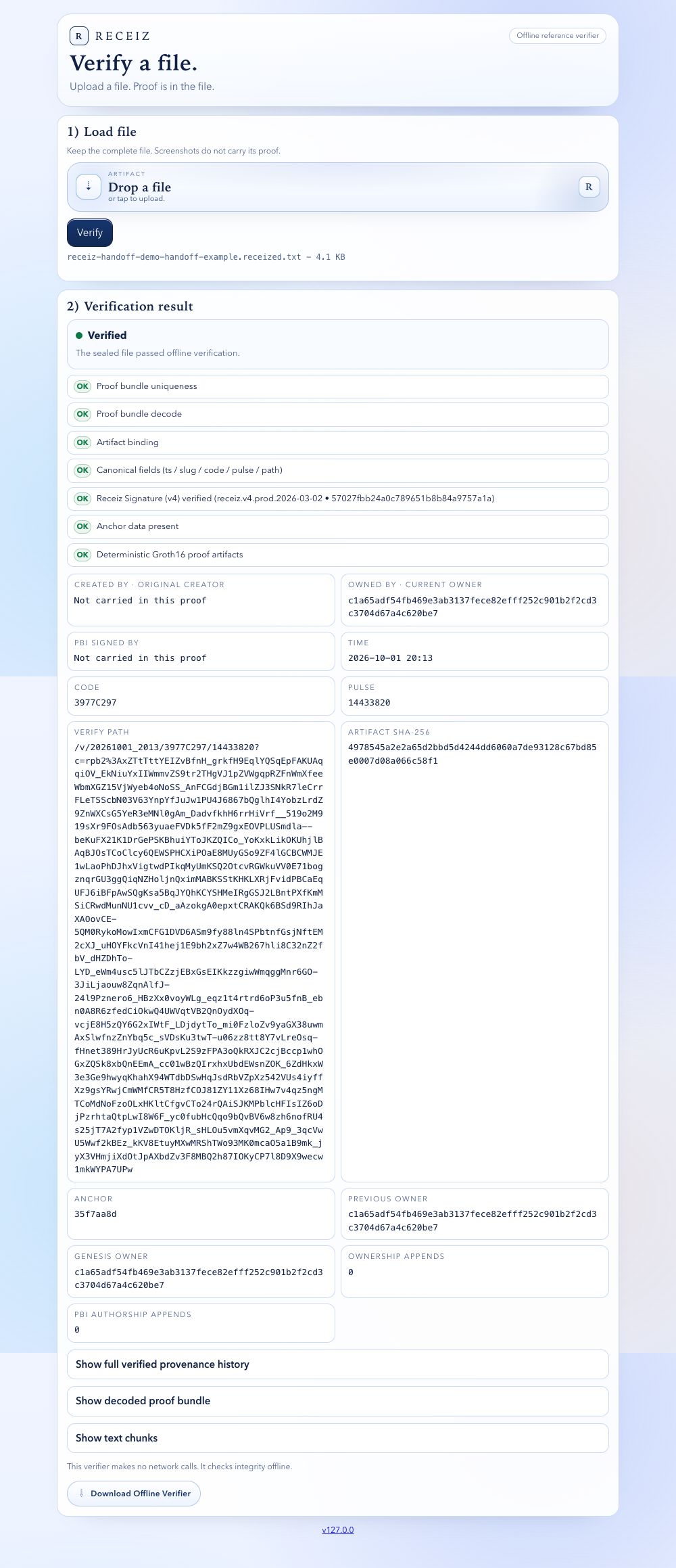
Receiz verifier interface. Verify your selected file to obtain its own result.
What the evidence establishes.
Tamper evidence detects violations of the artifact’s proof rules. It does not prevent someone from creating a different file, guarantee confidentiality, or prove that every statement inside the original is factually correct.
Questions before you start.
Is a checksum the same as a Receiz proof object?
A checksum can compare bytes against a known reference. A Receiz proof object carries the supported sealed proof and verification material for the original. A newly calculated hash of an untrusted file does not replace verification of its enclosing proof.
Can legitimate later information be added?
Verified additions can extend governed history while preserving prior proof objects. Rewriting an earlier original and appending a new admitted event are different operations.
Does sealing encrypt the document?
Integrity verification and confidentiality are separate. Use the supported disclosure and protection controls required for the actual material; do not assume that a sealed file is encrypted.